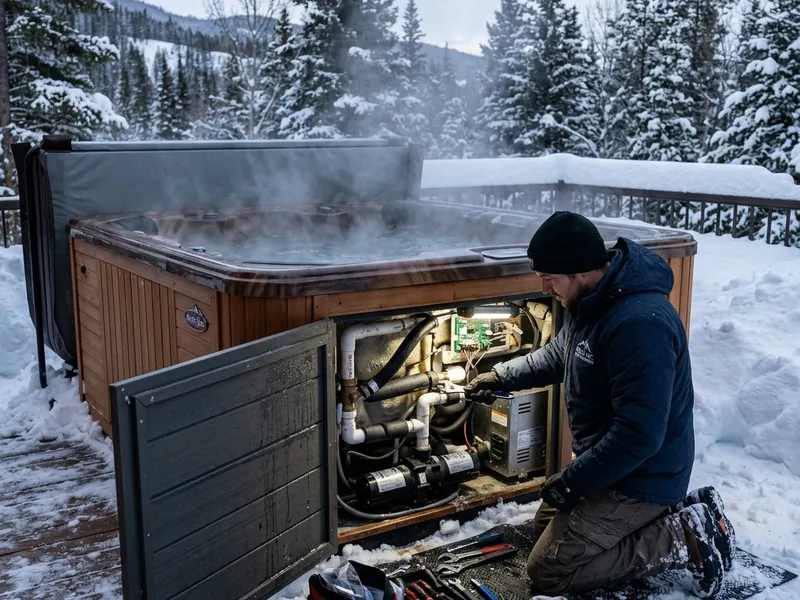
Repair vs. Replace: The Hot Tub Dilemma
When a major component fails on a spa that is 10, 15, or even 20 years old, every homeowner faces the same agonizing question: "Is it worth repairing a hot tub this old, or should I just throw it away and buy a new one?"
As a repair-first network, we've helped thousands of homeowners navigate this decision. While salespeople at hot tub dealerships will almost always push you toward a $10,000 replacement—often using high-pressure tactics about "energy efficiency" or "obsolete parts"—the math usually heavily favors repairing your existing tub.
In this comprehensive guide, we will break down the true costs of replacing a hot tub, debunk the energy efficiency myth, and explain exactly when you should repair your spa and when you should send it to the landfill.
The Hidden Costs of Replacing a Hot Tub
When considering buying a new hot tub, homeowners often look at the sticker price and forget the massive hidden costs involved in the swap. Removing an old hot tub and installing a new one is a major logistical project.
Let's break down the realistic costs of a hot tub replacement:
| Expense Type | Estimated Cost |
|---|---|
| New Hot Tub (Mid-Tier Acrylic) | $8,000 – $15,000 |
| Removal & Disposal of Old Tub | $400 – $800 |
| Electrical Code Updates (If required) | $300 – $1,000 |
| Delivery, Crane (If needed), & Setup | $300 – $1,500 |
| Total Replacement Cost | $9,000 – $18,300 |
Now, let's compare that to a "catastrophic" repair bill on your old tub. Let's say your 15-year-old Jacuzzi needs a brand new control board, a new heater, and a rebuilt primary pump. That is essentially a complete mechanical overhaul. A repair bill of that magnitude might cost $1,500 to $2,000.
When you compare a $2,000 repair to a $12,000 replacement project, the answer becomes much clearer: repairing is vastly more economical. By replacing the internal components, you are essentially giving your old spa a brand new heart and brain. The water doesn't know how old the acrylic shell is; it only knows that the new heater and pump are keeping it perfectly warm and clean.
Debunking the Energy Efficiency Myth
The most common argument dealers use to convince you to replace your tub is energy efficiency. They claim that new tubs are so well-insulated and use such efficient pumps that they will "pay for themselves" in electricity savings.
Let's look at the actual math.
From Quora: Do new hot tubs really save that much electricity? Experts on Quora and various spa forums highlight that while new tubs are more efficient, the math rarely justifies a $10,000 purchase.
Let's assume your old, poorly insulated tub costs $60/month to run. Let's assume a brand new, highly efficient tub costs $30/month to run. You are saving $30 a month, or $360 a year.
It would take over 27 years in electricity savings to pay off a $10,000 new hot tub.
Unless you are buying a new hot tub because you genuinely want new features (like Bluetooth audio, more jets, or a different seating layout), buying a new tub purely to save money on electricity is a terrible financial decision.
Need Professional Hot Tub Repair?
We have verified technicians available nationwide.
The Lifespan of the Acrylic Shell
The determining factor in whether a hot tub is worth repairing is almost always the condition of the structural shell and frame, not the mechanical components.
Mechanical components (pumps, heaters, control boards) are designed to be replaced. They wear out over time. However, the heavy fiberglass and acrylic shell that holds the water is designed to last for decades.
As long as the acrylic shell is structurally sound (no massive cracks leaking water) and the underlying wooden or metal frame hasn't rotted away, the tub is a perfectly viable vessel for holding hot water. You can always bolt on a new $400 pump to a 20-year-old shell, and it will run like a dream.
When You SHOULD Replace Your Hot Tub
While we advocate for repair 90% of the time, there are specific scenarios where replacing the hot tub is genuinely the better option:
- Catastrophic Shell Failure: If the fiberglass/acrylic shell has a massive structural crack that spans several feet and is actively leaking hundreds of gallons, it is often unrepairable. While small surface blisters can be patched, deep structural fissures compromise the integrity of the vessel.
- Severe Termite or Rot Damage: If the wooden frame supporting the heavy tub has rotted away due to years of slow, undetected leaks or termite infestations, the tub cannot hold the immense weight of the water safely. Attempting to rebuild the frame is usually more labor-intensive than buying a new tub.
- Pervasive Foam Leaks (The "Sponge" Effect): Many high-end spas are "full-foam," meaning the entire cabinet is filled with spray foam insulation. If the plumbing develops dozens of micro-leaks buried deep inside the foam, the foam acts like a sponge, soaking up the water. The labor required to dig out hundreds of pounds of wet foam to locate and fix every tiny leak can exceed $3,000. In these rare cases, replacement might be the better choice.
- Obsolete Proprietary Parts: While very rare, some boutique spa manufacturers from the 1990s went out of business and used highly proprietary control systems that can no longer be sourced. However, even in this scenario, a skilled technician can often "retro-fit" the tub by ripping out the old proprietary system and installing a modern, generic Balboa control pack.
Conclusion: Don't Give Up on Your Old Spa
Unless your tub is structurally collapsing or sinking into your deck, it is almost always worth repairing an older hot tub.
Before you visit a dealership and sign a financing agreement for a $12,000 spa, call a local, independent repair technician. For a small diagnostic fee, they can assess the exact condition of your tub, provide a firm quote for the mechanical repairs, and give you an honest opinion on the lifespan of the shell. More often than not, a few hundred dollars in repairs will have your old spa bubbling away for another decade.